
Perimenopause
YOUR QUESTIONS ANSWERED
“I don’t feel like myself anymore.”
If you’ve said this recently, you’re not alone and you’re not imagining the changes happening in your body.
Perimenopause is the transition leading up to menopause. It can begin years before your final menstrual period, often during your 40s and sometimes earlier. For me I was 35 when I was driving down I75, which Ive done hundreds of times. For some reason I was nervous. I was sweating from every orifice in my body. What would come next Id never have guessed.
And here’s one of the most important things to understand:
Perimenopause is not simply a state of “low estrogen.”
Your hormones are changing and sometimes changing dramatically.
Estrogen can rise, fall, surge and fall again. Progesterone production may become less consistent as ovulation becomes less predictable. Testosterone and other hormones may change as well.
That is why one month you may feel fantastic and the next month wonder what happened to you.
At House of Hormones & Weight Loss, we look beyond a single laboratory number. We consider your symptoms, menstrual pattern, medical history, lifestyle, medications, laboratory results and how you actually feel.
 Perimenopause is the hormonal transition between your reproductive years and menopause.
 Because your hormones can change from week to week- and day to day!
 This is one of the most common questions we hear.
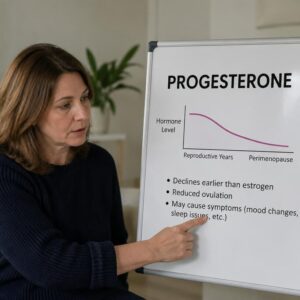 Progesterone is produced primarily following ovulation.
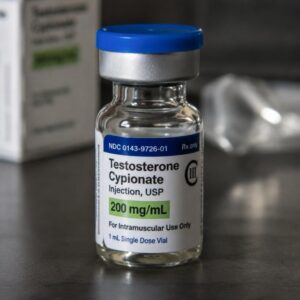 Women need testosterone too. Infect is my favorite hormone personally. Oh, the current of life (energy) it gives.
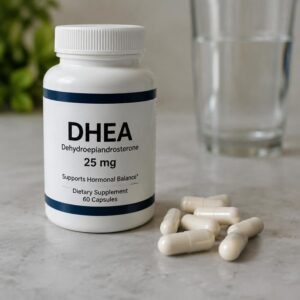 DHEA is an adrenal hormone that serves as a precursor for other sex hormones.
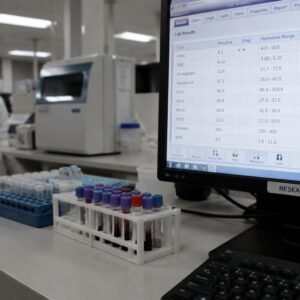 At House of Hormones & Weight Loss, patients receiving hormone therapy are typically evaluated by laboratory testing approximately twice each year after you are feeling well, with additional testing when clinically indicated and more when you are starting.
 Because there is a difference between chasing laboratory numbers and using laboratory information intelligently.
 How are you actually doing?
 Hormone optimization does not mean pushing every hormone to the top of a laboratory reference range.
 Hormone therapy has potential benefits and risks, and those risks are not identical for every woman.
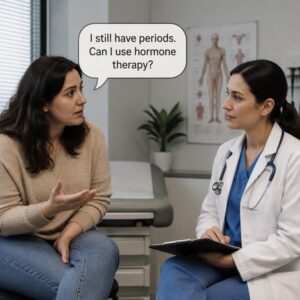 Potentially, yes.
 Midlife weight changes are complicated.
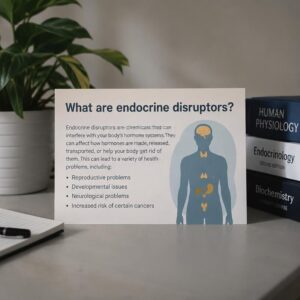 Your hormones don’t exist in a vacuum.
 Potential sources can include:
 Think reduce, not “live in a bubble.”
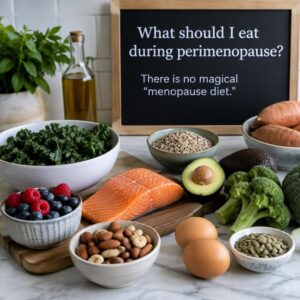 We generally encourage a nutrient-dense diet built around:
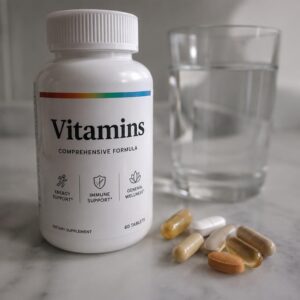 Sometimes supplements should have a reason.
 Sleep disruption is extremely common during the menopausal transition.
 Women who have never considered themselves anxious may notice significant mood changes during perimenopause.
 Sexual desire is complicated.
 Declining estrogen exposure can affect vulvar, vaginal and urinary tissues.
 Cycle changes are common during perimenopause, but abnormal bleeding should not automatically be blamed on hormones.
 Hormones should never be used to explain away potentially serious symptoms.
 There isn’t one timeline.
 No.
No.
